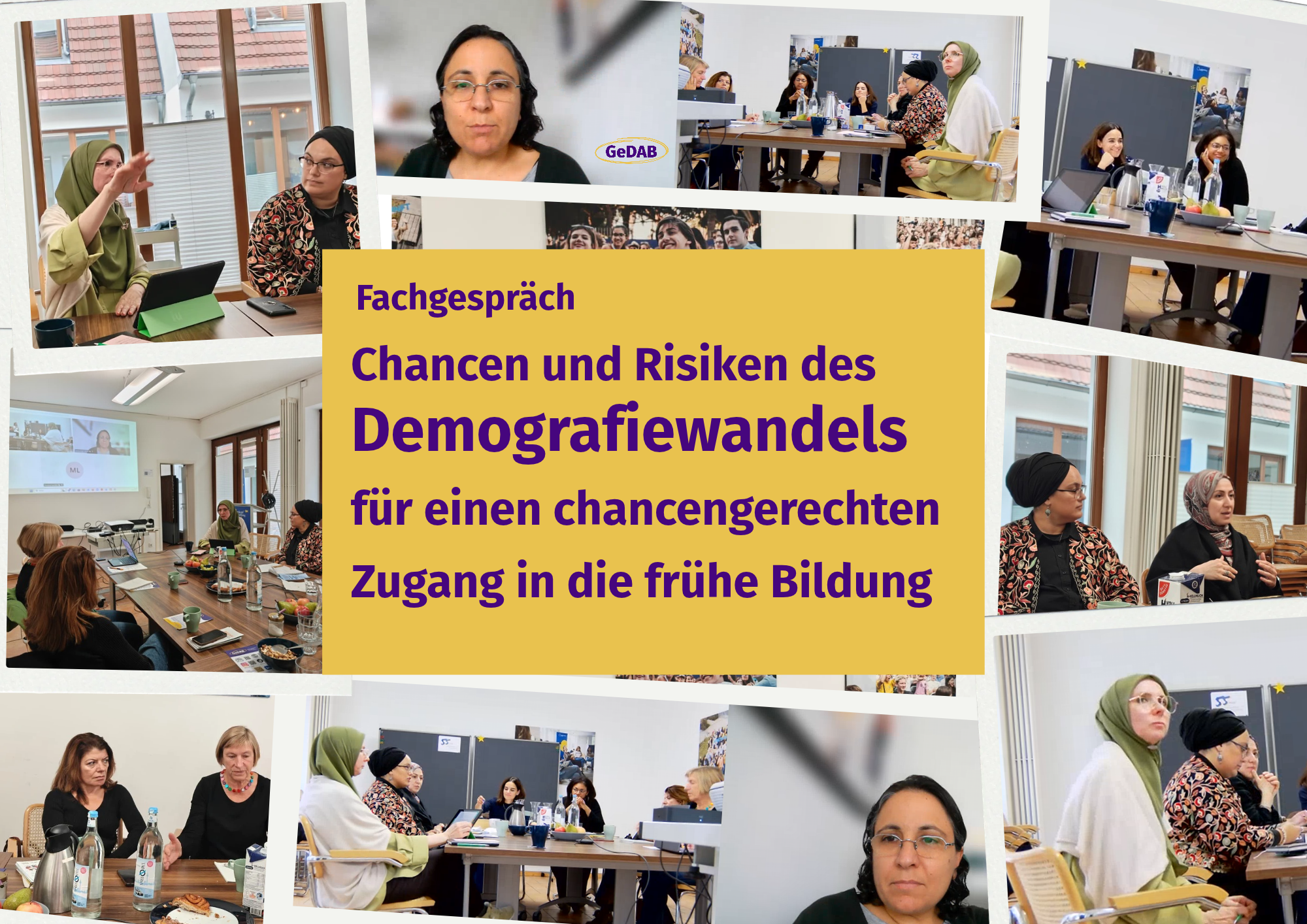
On September 24, 2026, the GeDAB network hosted an expert discussion titled “What Opportunities and Risks Does Demographic Change Present for Equitable Access to Early Childhood Education?” We deliberately invited experts with hands-on experience who themselves have ties to the immigrant community. All too often, people talk about them instead of with them, yet they are the ones who, drawing on their own experiences and daily practice, can best provide insights which either enables or hinders equitable access to early childhood education.
Access to early childhood education in Germany remains structurally unequal. Various barriers prevent all children from securing a spot in daycare. At the same time, the current decline in birth rates is changing the landscape: where daycare spots were previously in short supply, new opportunities are emerging. Against this backdrop, we addressed the question: Does this change actually lead to greater equality of opportunity, or are existing selection mechanisms merely shifting?
Access begins with trust
In her presentation, “Access Through Trust—Intercultural Openness in Early Childhood Education,” Pınar Çetik from the German Islam Academy gave us insight into how closely access and trust are linked.
In her presentation, it became clear that even small details can determine whether families feel welcome: whether a name is pronounced correctly, whether welcome information is displayed in multiple languages, or whether a team is diverse. Central to this was the motto “Attitude, not background.” This requires intercultural competencies and anti-bias approaches based on the “Anti-Bias Education and Upbringing” model developed by Kinderwelten. Responsibility for this must not rest solely on individual team members. It needs to be structurally embedded in policies, training, and the day-to-day operations of the daycare center.
Structures matter—not just good intentions
These findings were confirmed and expanded upon by Iman Reimann, director of the Regenbogenkids daycare center, who drew on more than 20 years of practical experience.
In her presentation, it became clear just how much external structures determine whether a genuine partnership with families in education and child-rearing is even possible in everyday life. One challenge she particularly highlighted concerns widespread assumptions about parents: If a parent is hastily labeled as “hard to reach” or “uninterested,” the question of whether the actual obstacle might instead be the way the parent is approached, whether the timing of a parent-teacher conference or the lack of a translation is the real obstacle. It is important to shift the perspective: Instead of asking what steps families must take, the focus should be on what conditions are necessary for an effective partnership and how educational professionals can ensure these conditions are met. To do this, institutions need time, personnel, and appropriate professional development.
What True Participation Requires
A key finding of the expert discussion was therefore that demographic change does not automatically lead to greater equality of opportunity. While the declining birth rate means there are more available daycare spots, this does not automatically result in more children attending daycare. Structural changes are needed to take advantage of the opportunities this shift offers.
This includes smaller group sizes, so that the needs and concerns of individual children can be addressed more effectively, as well as time and informational resources for early childhood educators. Equally important are diverse teams that reflect the diversity of families, and easy access to language interpreters, so that communication does not depend on individuals having to improvise. Families also need low-barrier complaint procedures that are embedded in a genuine culture of feedback, where feedback is welcomed and leads to change. Last but not least, it is important to strengthen trust in communities that, just a few years ago, were met with closed doors. This trust does not arise on its own: government agencies, organizations, and institutions must actively build it.
We would like to express our sincere thanks for the insightful contributions and the stimulating discussion. We would also like to thank all participants for their suggestions, their expertise, and the open exchange of ideas.