About the Network
The Network for Joint Democracy-Building in Early Childhood Education is for everyone who is committed to ensuring equal educational opportunities.
Our Mission
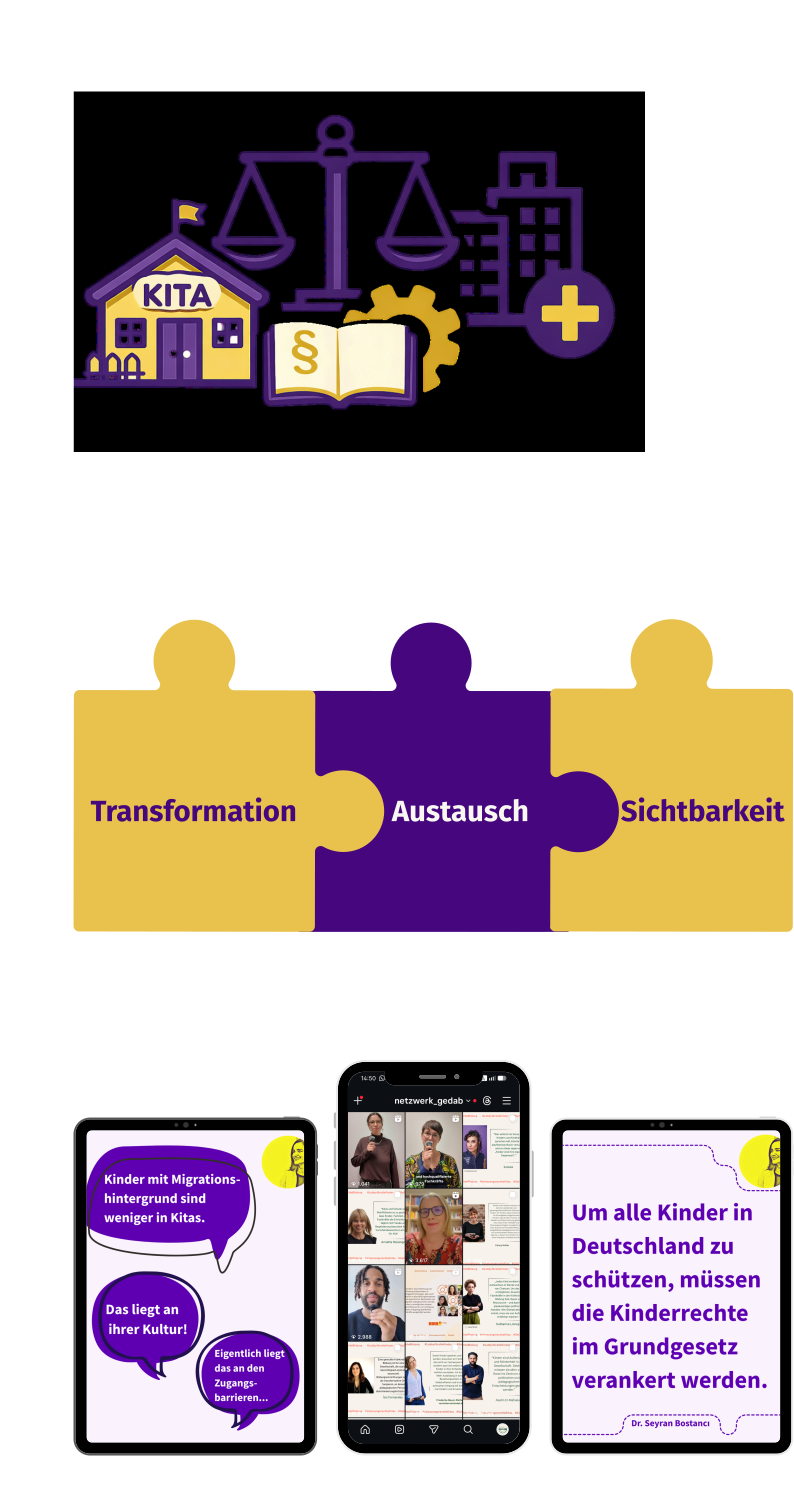
The Network for Joint Democracy-Building in Early Childhood Education (GeDAB) is committed to identifying barriers to access to high-quality education for young children and working to eliminate them. The network advocates for early childhood education that promotes democracy and participation and consistently aligns its structures, resources, and action plans with the UN Convention on the Rights of the Child. In doing so, we take into account the children’s different living conditions as well as the varied—and in some cases multiple—forms of disadvantage and discrimination they face, which can reinforce one another. Inclusive approaches that challenge discrimination and strengthen democracy are essential, because education can only succeed if structural barriers are identified and eliminated.
Our Approach
We take a multi-perspective approach and facilitate dialogue among academia, practitioners, policymakers, government agencies, civil society, and the business community to translate scientific findings into action and break down barriers to education. By creating a nationwide forum for professional exchange, consultation, and knowledge transfer, we ensure that educational equity is structurally embedded. In addition, we support government agencies and state-level initiatives in making access more understandable, reliable, and equitable, because trust is built when institutions are accessible and take into account people’s diverse life experiences.
Our Impact
GeDAB highlights where educational barriers exist and helps stakeholders make access to education more understandable, reliable, and equitable. In this way, we help build trust between institutions and families and drive structural changes that promote greater equity of opportunity in early childhood education. Through networking and policy analysis, we bring key facts to the table in debates and support structural improvements. This leads to lasting changes in administrative procedures, policy initiatives, organizational structures, and educational practices. This is how GeDAB promotes children’s rights, participation, and a culture of democracy within the early childhood education system
Blog
-
Statement on the Planned Mandatory Language Tests & ABC Classes
As part of the planned language assessment and the preparatory year for school readiness, Dr. Seyran Bostancı, Dr. Anna Aleksandra Wojciechowicz, and Benedikt Wirth have authored a scientific statement.
-
Statement on the Planned ABC Classes in North Rhine-Westphalia
Analytical statements on the planned language screenings and ABC classes in North Rhine-Westphalia and their impact on language education and educational inequalities.
Our Newsletter
The newsletter is published 3–4 times a year and provides information on the topic of building democracy together in early childhood education.
We use Rapidmail to send out our newsletter. Please also review our privacy policy.